The NIST AI RMF is voluntary, which is exactly why it is hard to operationalise: nothing forces the paperwork, so the framework tends to live in a slide deck rather than in the systems it describes. UrNammu seeds the framework at the category level — the level a per-system attestation can actually carry — and attaches it to the AI systems and agents in your registry.
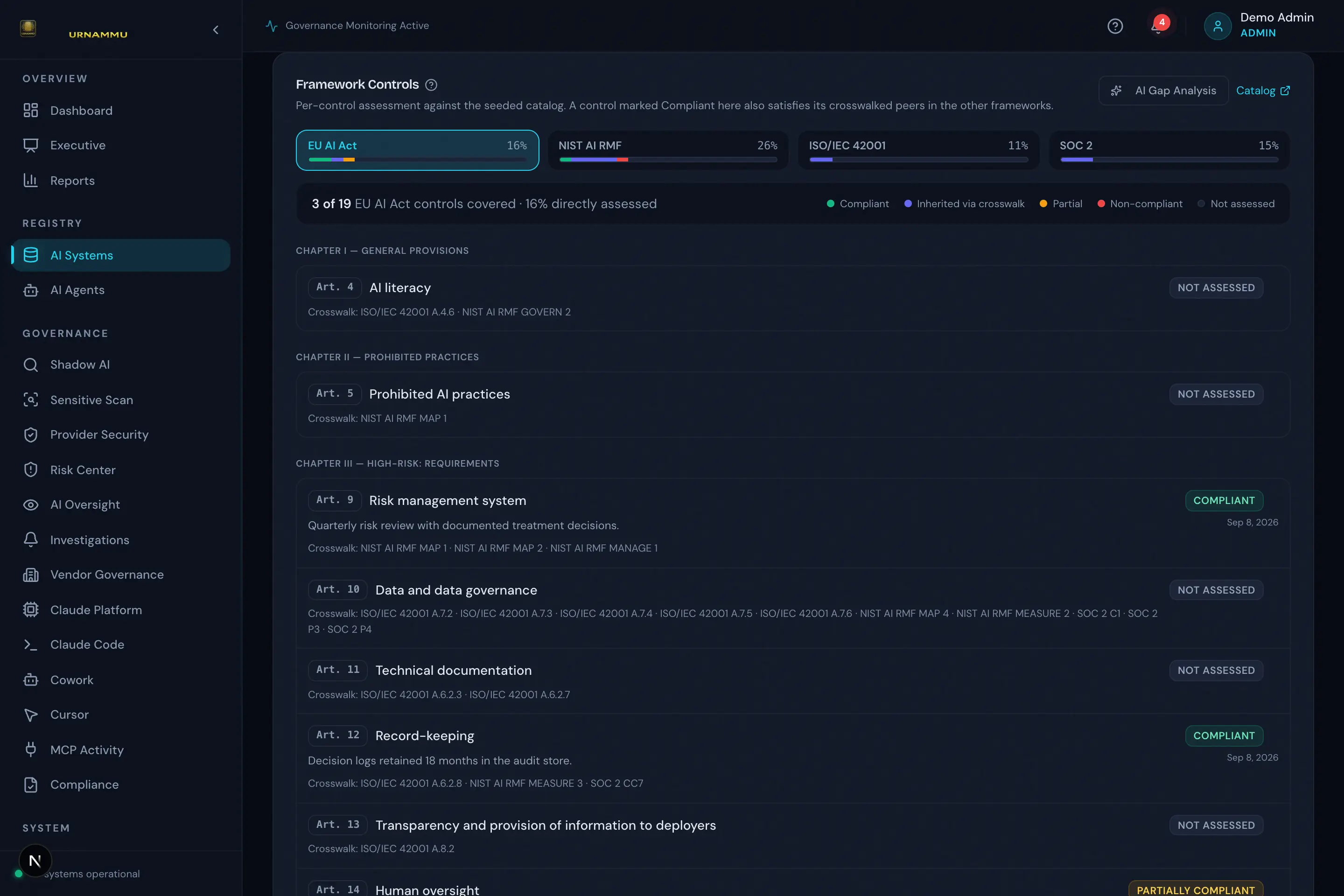
Control catalog — assess each function control by control, with evidence attached
Seeded controls, by function
Govern
6Policies and procedures for AI risk, accountability structures, workforce DEIA, risk culture, engagement with AI actors, and third-party and supply-chain risk policies.
Map
5Context, categorisation of the system, capabilities and expected benefits and costs, risks and benefits of all components, and impacts to individuals, groups and society.
Measure
4Appropriate methods and metrics, evaluation for trustworthy characteristics, tracking identified risks over time, and feedback on measurement efficacy.
Manage
4Prioritising and responding to risk, maximising benefits and minimising harms, managing third-party risk, and treatment, response, recovery and communication plans.
How UrNammu covers it
Govern maps to the registry and approvals
GOVERN 1 and 2 ask for policies, procedures and accountability structures. UrNammu holds the policies, assigns them to systems, records staged Owner / Security / Legal / Compliance sign-off with rationale, and keeps time-bound exceptions that expire on their own rather than quietly persisting.
Map is the registry, filled in
Each AI system and agent carries context, purpose, owner, vendor, data sensitivity, deployment status and an inventory of components and capabilities — including which MCP servers and tools an agent may call.
Measure is the Risk Center
Multi-dimensional risk scoring across bias, security, privacy, fairness, performance and transparency, with heat maps, agent-aware overlays, and assessments that re-score a system over time so MEASURE 3 has a trend rather than a snapshot.
Manage has teeth at the proxy
Risk treatments are not only documented. Policy-as-code rules run at the AI proxy in off, dry-run or enforce mode, every block lands in the Policy Denials log, and governance incidents tie the response back to the alert that triggered it.
Frequently asked questions
Why category level rather than subcategory level?
NIST AI RMF subcategories are too granular for a per-system attestation and mostly map many-to-one onto their category anyway. UrNammu seeds GOVERN 1–6, MAP 1–5, MEASURE 1–4 and MANAGE 1–4, which is the level at which a system owner can meaningfully answer.
Is NIST AI RMF enough on its own?
It is voluntary and US-oriented, so most organisations run it alongside something binding or certifiable. The seeded crosswalk links NIST controls to EU AI Act articles, ISO/IEC 42001 Annex A controls and SOC 2 criteria, so one assessment can satisfy several.
Does it cover AI agents, not just models?
Yes. Agents are first-class in the registry with autonomy levels and human-in-the-loop rules, and the MCP servers and tools they may call are governed by allowlist and observed at the proxy — which is what MAP 4 and MANAGE 3 ask for when the components are third-party tools.
UrNammu is governance software, not legal advice. Control mappings and derived risk tiers are inputs to your own legal and compliance review.
Other frameworks
EU AI Act
Classify each AI system’s EU AI Act risk tier, derive the obligations that follow, and evidence them control by control against 19 seeded articles.
EU AI Act Compliance Software →ISO/IEC 42001
Run an ISO/IEC 42001 AI management system on real data: 38 seeded Annex A controls assessed per system, with evidence, coverage roll-ups and an audit trail.
ISO 42001 Compliance Software →SOC 2
Bring the AI estate into SOC 2 scope: 20 seeded Trust Services Criteria per system, with access, change and monitoring evidence produced by the proxy.
SOC 2 Compliance for AI Systems →